"80% of science fiction films will be a reality within a century"
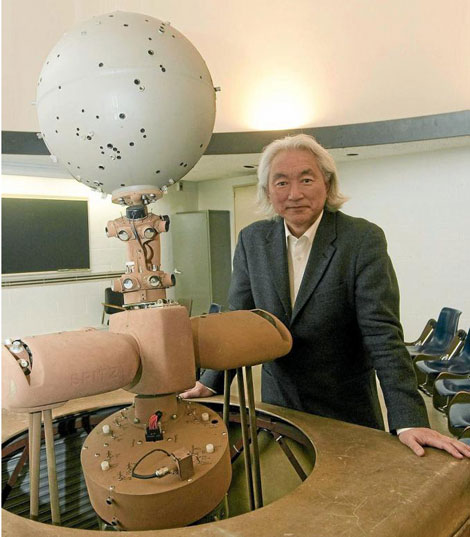
Michio Kaku manages controls City College Planetarium like Captain Spock, in front of the ship Enterprise.A 62, this physicist specializing in string theory has been accomplished as one of the greatest science communicators of the earth, looking ahead to the future more or less imminent drawing in 'Physics of the Impossible' (Debate). With your feet on earth, Kaku says that the boundary between science and fiction is increasingly blurred, asserting that "man's natural destination is in the stars."
.- Question Time travel, teleportation, invisibility, parallel universes .... How much and how much science fiction in the future you draw?
Answer .- When I wrote Physics of the impossible, I saw many science fiction films with a background premise: how many of these things will eventually be possible? My conclusion is that 80% of everything we see in movies is actually in a century.
P. - Let's start with what you call 'impossibilities' of first class. When does the magnetic levitation trains and cars 'floating'?
R. - The Maglev existing experimental level in England, Japan and China. Move without friction and literally float in the air. What prevents their commercialization is cost, but it is one of the "impossibilities" that fall in a matter of years. The cars 'floating', which would function primarily as helicopters, pose more technical difficulties and are much more difficult to recoup. The jet packs or "rocket backpack" are also a reality, but we have barely been able to fly for 30 seconds. Here the problem is fuel, but may be resolved in the future with the nanobaterías.
Interview
Q. - When will the man standing Mars?
A. - I think it will be possible between 2030 and 2040, but with current technology, which are used for the Orion spacecraft that is to return to the moon, we would send carísimo.Para a manned (and returning) is going to need another type of fuel. Princeton University is experimenting with plasma or ionized gas, that may be the solution to explore the Solar System.
Q. - When will the antimatter-powered ships like Star Trek?
R. - That's an impossibility for most distant the perennial problem: cost. Although we have the closest thing to a starship within a century. For now, anti-feeding scenarios as will be seen in Angels and Demons, starring Tom Hanks, in which a group of deluded intended to blow up the Vatican with an antimatter bomb. The fiction is always far ahead.
Q. - Will soon the cyborg or the man-machine?
A. - We have also made great strides in this area. The most fascinating is perhaps the Brain Gate of John Donoghue, a neuroscientist at Brown University. It consists of a microchip that is implanted on the brain that regulates motor activity. The signals are processed by a computer which can translate into mechanical movements. It is a great advance in the mind-machine interface. Think of applications that can be paraplegic.
Q. - You predicted that the invisibility and teleportation are also just around the corner ...
R. - The Invisibility Cloak and has already been tested by British and American scientists, who have removed an object by deflecting the microwaves around. Teleportation is also true: we take an atom and move it from one end to a room. The next step will teleport molecules, or even a gene. A cell is much more difficult, let alone a human being, given that we are composed of 50 trillion cells. We would have to die before and be reformed, as Captain Kirk in Star Trek ...
Q. - Where is the boundary between science and fiction?
R. - The border is often very diffuse, and have always been visionaries like Jules Verne, with the help of scientists caught a glimpse of Paris in the twentieth century. Fax, glass skyscrapers, gasoline cars ... Verne wrote about all that when viewed as something "impossible", and yet here we are.
Q. - Do you feel closer to Einstein or Flash Gordon?
R. - In my comics I saw the first Flash Gordon television screens long before they were actually ... Einstein was another hero of my childhood: I was fascinated by the fact that the death left unfinished his Theory of Everything. That has been my commitment as a scientist.
Q. - How do you your work combines research and the science writer?
R. - I love physics, and I love to tell it. Before a scientist trying to explain things to ordinary mortals he looked down. That all changed thanks to Stephen Hawking and his History of Time.
Q. - What do you think that a Nobel Prize in Physics, Steven Chu, take the reins of power in the U.S.?
R. - Obama's commitment to science is totally lógica.Al After all, science has always been the engine of progress and wealth. The problem is that wealth makes us greedy, and regularly fall into crisis like this. Obama has also put his finger on the pulse of change climate: we can not keep pouring CO2 into the atmosphere must urgently turn to clean energy.
Q. - What is the energy of the future?
R. - We expect years of total chaos, but in a decade for a complete transition to renewable energy. Nuclear fission has proved a very dangerous choice: we can not afford to move to the next generation highly radioactive waste for millions of years. The future of solar energy will be combined with hydrogen, but in 30 years or so the merger will be realized that the end of the day is the energy of the stars.
Source: http://www.elmundo.es/elmundo/2009/05/03/ciencia/1241339302.html
Michio Kaku manages controls City College Planetarium like Captain Spock, in front of the ship Enterprise.A 62, this physicist specializing in string theory has been accomplished as one of the greatest science communicators of the earth, looking ahead to the future more or less imminent drawing in 'Physics of the Impossible' (Debate). With your feet on earth, Kaku says that the boundary between science and fiction is increasingly blurred, asserting that "man's natural destination is in the stars."
.- Question Time travel, teleportation, invisibility, parallel universes .... How much and how much science fiction in the future you draw?
Answer .- When I wrote Physics of the impossible, I saw many science fiction films with a background premise: how many of these things will eventually be possible? My conclusion is that 80% of everything we see in movies is actually in a century.
P. - Let's start with what you call 'impossibilities' of first class. When does the magnetic levitation trains and cars 'floating'?
R. - The Maglev existing experimental level in England, Japan and China. Move without friction and literally float in the air. What prevents their commercialization is cost, but it is one of the "impossibilities" that fall in a matter of years. The cars 'floating', which would function primarily as helicopters, pose more technical difficulties and are much more difficult to recoup. The jet packs or "rocket backpack" are also a reality, but we have barely been able to fly for 30 seconds. Here the problem is fuel, but may be resolved in the future with the nanobaterías.
Interview
Q. - When will the man standing Mars?
A. - I think it will be possible between 2030 and 2040, but with current technology, which are used for the Orion spacecraft that is to return to the moon, we would send carísimo.Para a manned (and returning) is going to need another type of fuel. Princeton University is experimenting with plasma or ionized gas, that may be the solution to explore the Solar System.
Q. - When will the antimatter-powered ships like Star Trek?
R. - That's an impossibility for most distant the perennial problem: cost. Although we have the closest thing to a starship within a century. For now, anti-feeding scenarios as will be seen in Angels and Demons, starring Tom Hanks, in which a group of deluded intended to blow up the Vatican with an antimatter bomb. The fiction is always far ahead.
Q. - Will soon the cyborg or the man-machine?
A. - We have also made great strides in this area. The most fascinating is perhaps the Brain Gate of John Donoghue, a neuroscientist at Brown University. It consists of a microchip that is implanted on the brain that regulates motor activity. The signals are processed by a computer which can translate into mechanical movements. It is a great advance in the mind-machine interface. Think of applications that can be paraplegic.
Q. - You predicted that the invisibility and teleportation are also just around the corner ...
R. - The Invisibility Cloak and has already been tested by British and American scientists, who have removed an object by deflecting the microwaves around. Teleportation is also true: we take an atom and move it from one end to a room. The next step will teleport molecules, or even a gene. A cell is much more difficult, let alone a human being, given that we are composed of 50 trillion cells. We would have to die before and be reformed, as Captain Kirk in Star Trek ...
Q. - Where is the boundary between science and fiction?
R. - The border is often very diffuse, and have always been visionaries like Jules Verne, with the help of scientists caught a glimpse of Paris in the twentieth century. Fax, glass skyscrapers, gasoline cars ... Verne wrote about all that when viewed as something "impossible", and yet here we are.
Q. - Do you feel closer to Einstein or Flash Gordon?
R. - In my comics I saw the first Flash Gordon television screens long before they were actually ... Einstein was another hero of my childhood: I was fascinated by the fact that the death left unfinished his Theory of Everything. That has been my commitment as a scientist.
Q. - How do you your work combines research and the science writer?
R. - I love physics, and I love to tell it. Before a scientist trying to explain things to ordinary mortals he looked down. That all changed thanks to Stephen Hawking and his History of Time.
Q. - What do you think that a Nobel Prize in Physics, Steven Chu, take the reins of power in the U.S.?
R. - Obama's commitment to science is totally lógica.Al After all, science has always been the engine of progress and wealth. The problem is that wealth makes us greedy, and regularly fall into crisis like this. Obama has also put his finger on the pulse of change climate: we can not keep pouring CO2 into the atmosphere must urgently turn to clean energy.
Q. - What is the energy of the future?
R. - We expect years of total chaos, but in a decade for a complete transition to renewable energy. Nuclear fission has proved a very dangerous choice: we can not afford to move to the next generation highly radioactive waste for millions of years. The future of solar energy will be combined with hydrogen, but in 30 years or so the merger will be realized that the end of the day is the energy of the stars.
Source: http://www.elmundo.es/elmundo/2009/05/03/ciencia/1241339302.html


0 comments:
Post a Comment